

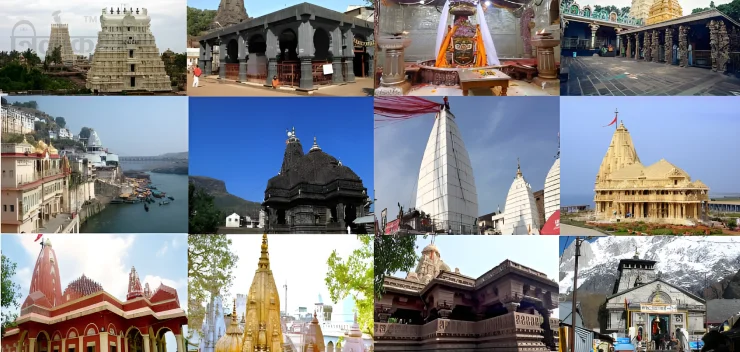


| Jyotirlinga Name | Geographical Location | Key Unique Scriptural Feature / Legend |
|---|---|---|
| 1. Somnath | Prabhas Patan, Gujarat | The absolute first Jyotirlinga; freed the Moon God from Daksha’s curse. |
| 2. Nageshwar | Near Dwarka, Gujarat | Features a massive 25-meter Shiva statue; destroyed the demon Daruka. |
| 3. Bhimashankar | Pune, Maharashtra | Situated on the Bhima River; links directly with Parvati’s protective presence. |
| 4. Trimbakeshwar | Nashik, Maharashtra | Houses three unique lingas representing the Holy Trinity (Brahma-Vishnu-Shiva). |
| 5. Grishneshwar | Aurangabad, Maharashtra | Built of red stone near Ellora caves; manifested for devotee Ghushma. |
| 6. Vaidyanath | Deoghar, Jharkhand | Houses the sacred Atmalinga permanently grounded by Ravana. |
| 7. Mahakaleshwar | Ujjain, Madhya Pradesh | The only south-facing (Dakshinamurti) shrine; famous for Bhasma Aarti. |
| 8. Omkareshwar | Narmada River, Madhya Pradesh | The island naturally mirrors the holy Om symbol; paired with Mamleshwar. |
| 9. Kashi Vishwanath | Varanasi, Uttar Pradesh | The primary manifestation of Shiva’s energy; the city of complete salvation. |
| 10. Kedarnath | Rudraprayag, Uttarakhand | Sits at 12,000 feet in the Himalayas; constructed by the Pandavas. |
| 11. Rameshwaram | Rameswaram Island, Tamil Nadu | Personally installed and worshipped by Lord Rama before the Lanka war. |
| 12. Mallikarjuna | Srisailam, Andhra Pradesh | Sits on Srisailam Hill; uniquely co-located with a Shakti Peeth. |
1. The Shrines of Western India (Gujarat & Maharashtra)
Western India holds the historical starting gates of the pilgrimage trail, housing five major centers of intense tectonic devotion:
Somnath Jyotirlinga (Gujarat)
Standing grandly in the ancient Prabhas region of coastal Gujarat, Somnath is universally recognized as the absolute first among the 12 Jyotirlingas. According to stellar Puranic legends, Prajapati Daksha, the son of Lord Brahma, had 27 daughters who were all wedded to the Moon God (Chandra Dev). However, Chandra favored his most radiantly beautiful wife, Rohini, while completely ignoring the others.
Infuriated by this ongoing injustice, Daksha cast a severe curse causing Chandra to lose his beauty, vital luster, and brilliance. To reverse this dark degeneration, Chandra established a rigorous, prolonged penance to worship Lord Shiva at this spot. Moved by his devotion, Shiva granted Chandra a renewed cycle of life, giving rise to the structural waxing and waning phases of our moon.
Nageshwar Jyotirlinga (Gujarat)
Positioned near the sacred coastal city of Dwarka—the sovereign land of Lord Krishna—the Nageshwar shrine is enhanced by a majestic 25-meter-tall external Shiva statue and manicured, lush botanical gardens. Lord Shiva resides here as Nageshwar alongside Goddess Parvati in her form as Nageshwari. He originally manifested at this geographic point to completely destroy the tyrant demon Daruka and secure the safety of local sages.
Bhimashankar Jyotirlinga (Maharashtra)
This major temple sits comfortably high on the banks of the pristine Bhima River near Pune. Traditional local histories state that Bhima, the powerful son of Kumbhakarna, built the foundations of this shrine. Located immediately adjacent to the main altar lies a dedicated temple of Mata Parvati, serving as a permanent energetic monument to the deep, eternal bond shared between Shiva and Parvati. Note that some alternative regional traditions map this specific scriptural line near the Kamakhya shrines in Assam.
Trimbakeshwar Jyotirlinga (Maharashtra)
This architectural landmark stands at the foot of the Brahmagiri Hills in Nashik—the physical origin point of the holy Godavari River, scripturally known as the Gautami Ganga. After Sage Gautama established long prayers here to cleanse a deep karmic block, Shiva manifested permanently as Trimbakeshwar. Uniquely, the interior sanctum features a three-faced linga representing the complete Hindu Trinity: Lord Brahma, Lord Vishnu, and Lord Shiva.
Grishneshwar Jyotirlinga (Maharashtra)
Constructed out of rich red basalt stone, this temple is situated near the world-famous UNESCO heritage Ajanta and Ellora caves in Aurangabad. Its classical architecture is heavily adorned with extensive, intricate carvings of ancient deities. Lord Shiva emerged from an infinite pillar of light here to answer the deep devotion of a pious lady named Ghushma, giving the shrine its permanent name of Grishneshwar.
2. The Shrines of Central & Eastern India (Madhya Pradesh & Jharkhand)
The central and eastern landscapes anchor the raw, unshakeable forces of absolute Time, cosmic layout, and deep demonic subduing:
Mahakaleshwar Jyotirlinga (Madhya Pradesh)
Located in the ancient spiritual capital of Ujjain, Lord Shiva appears here as the Sovereign ruler of absolute Time (Kaal). This landmark stands unique as the only south-facing (Dakshinamurti) Jyotirlinga across the cosmos, rendering its energy exceptionally powerful for destroying death-fears and severe health blockages. Devotees gather daily to witness the legendary, life-altering Bhasma Aarti. Shiva revealed Himself at this spot to protect his local seekers in response to a young child’s unshakeable, pure devotion.
Omkareshwar Jyotirlinga (Madhya Pradesh)
This temple is uniquely situated on a natural island slicing through the sacred Narmada River, where the island’s geography naturally mirrors the geometric pattern of the cosmic **Om symbol**. Lord Shiva manifested here, deeply pleased by the intense royal penance of King Mandhata. To secure the complete, rounded blessings of this geographic matrix, pilgrims must cross over and also visit the nearby Mamleshwar shrine.
Vaidyanath Jyotirlinga (Jharkhand)
Situated in the Deoghar district of Jharkhand, this sprawling temple structure houses the highly coveted Atmalinga. According to scriptural histories, the demon king Ravana performed grueling penance at Mount Kailash to obtain this concentrated linga of pure energy from Lord Shiva. Shiva allowed him to carry it to Lanka under one strict rule: if placed on the floor during transit, it would ground permanently. Tricksters intervened, forcing Ravana to set it down here in Deoghar, converting the ground instantly into an immovable Jyotirlinga.
3. The Shrines of Northern & Southern India (The Great Axis)
The final axis coordinates the ultimate portals of absolute liberation, epic historical events, and the reconciliation of familial deities:
Kashi Vishwanath Jyotirlinga (Uttar Pradesh)
Located in Varanasi—the oldest living spiritual city on Earth—this shrine is universally regarded as the absolute primary spot where Lord Shiva’s primordial energy first broke into the material universe. Devotees hold an unshakeable faith that dying or being cremated in Kashi grants instant salvation (Moksha) from the wheel of rebirth. Ancient texts reveal that whenever Mahadev steps away from Mount Kailash, He resides permanently inside Kashi.
Kedarnath Jyotirlinga (Uttarakhand)
Kedarnath sits at a breathtaking altitude of 12,000 feet, nestled deep within the snow-covered Garhwal Himalayas, serving as a primary pillar of the elite Char Dham pilgrimage circuit. Following the catastrophic destruction of the Kurma/Kurukshetra war, the Pandavas journeyed into these mountains, constructing this stone temple to perform intense penance and earn Lord Shiva’s absolute forgiveness for their wartime sins.
Rameshwaram Jyotirlinga (Tamil Nadu)
This sprawling, structural masterpiece dates directly back to the historical era of the Ramayana. Before crossing the ocean to launch his final war against Ravana, Lord Rama personally hand-crafted and installed this Shiva Linga on the shores of Rameswaram Island. His focused worship of Mahadev marked the formal, successful launch of his epic Lanka expedition.
Mallikarjuna Jyotirlinga (Andhra Pradesh)
Perched beautifully on the flat platany of the Srisailam Hill, this highly unique shrine was manifested when Lord Shiva and Mata Parvati journeyed down south to pacify and comfort their aggrieved son, Lord Kartikeya. Within this unique temple matrix, Shiva reflects the energy of Arjuna, while Parvati commands the space as Mallika. Crucially, the complex also houses the **Bhramarambika temple**, making it one of the rare spaces where a Jyotirlinga and a Maha Shakti Peeth exist co-located inside the same walls.
Conclusion: Activating the Cosmic Light Axis in Sawan
Ultimately, the 12 Jyotirlingas are far more than historical brick-and-mortar structures; they are active, multi-dimensional power grids carrying the undiluted life frequency of Mahadev. Whether you are seeking the emotional rebalancing of *Somnath*, traveling to the south-facing gates of *Mahakaleshwar* for health defense, or meditating on the Rama-installed lineage of *Rameshwaram*, keeping these stories alive during Sawan activates a protective shield across your horoscopic layout. Honor the light axis, ground your actions, and let Lord Shiva smooth your path forward!