
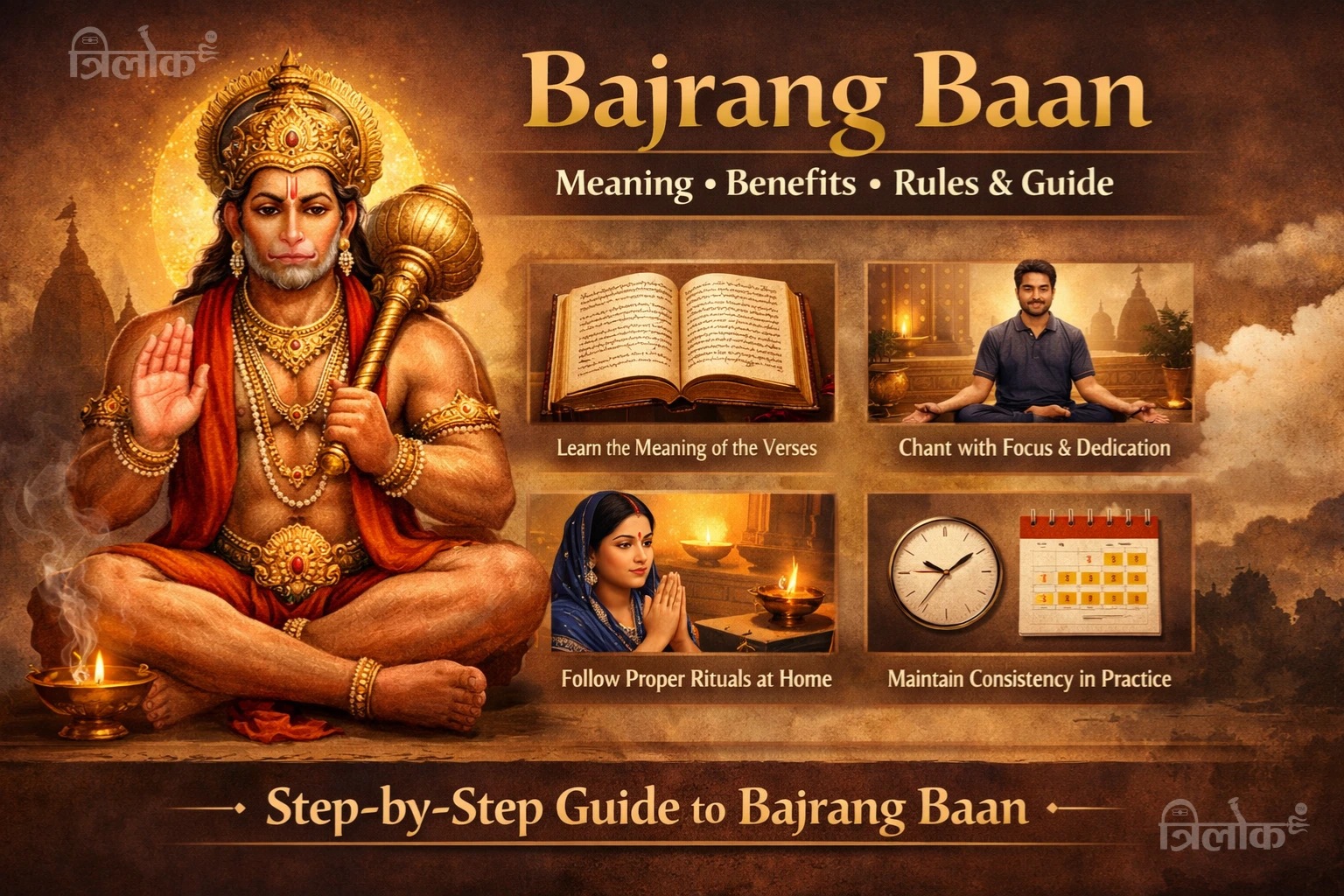
Bajrang Baan: Meaning, Benefits, Rules & Step-by-Step Guide

Bajrang Baan: Meaning, Benefits, Rules & Step-by-Step Guide

Bajrang Baan: Meaning, Benefits, Rules & Step-by-Step Guide

The Bajrang Baan is often searched during moments when problems feel urgent and solutions seem out of reach—but most people either don’t understand its correct usage or approach it with confusion. That gap is exactly why this blog exists: to provide a clear, practical, and result-oriented understanding of Bajrang Baan so it can be used effectively, not just emotionally.

What You’ll Learn in This Guide

  • Core Meaning of Bajrang Baan and its deeper significance

  • When to Recite for maximum effectiveness (timing + situations)

  • Rules & Best Practices to ensure correct and disciplined recitation

  • Step-by-Step Execution Framework for structured daily practice

  • Key Differences between Bajrang Baan and other prayers

  • Why it is considered a high-intensity spiritual practice dedicated to Lord Hanuman

For you, this isn’t just information—it’s a practical tool. When applied correctly, Bajrang Baan can help bring mental clarity, reduce fear, strengthen decision-making, and create a sense of inner control during uncertain situations.

Origin and Background of Bajrang Baan

What is Bajrang Baan?

The Bajrang Baan is a high-intent devotional composition dedicated to Lord Hanuman, engineered for focused invocation rather than passive praise. Unlike general stotras, it is recited when individuals seek decisive intervention—especially during periods of fear, uncertainty, or persistent obstacles. Its tone is assertive and action-driven, reflecting a mindset of urgency combined with unwavering faith.

From a practical standpoint, Bajrang Baan functions as a mental and spiritual alignment tool. It channels attention, reduces internal noise, and reinforces resilience by anchoring the mind to Hanuman’s attributes—strength, discipline, and devotion.

Origin of Bajrang Baan

Bajrang Baan is traditionally attributed to Goswami Tulsidas, a central figure in the bhakti movement and the author of the Ramcharitmanas. While there is no definitive historical documentation confirming authorship, its linguistic patterns, devotional intensity, and poetic structure closely mirror Tulsidas’s style.

It likely emerged within the broader Rama–Hanuman devotional tradition, designed as a specialized prayer for crisis resolution, rather than a general daily hymn.

Bajrang Baan in Ramcharitmanas

The Ramcharitmanas does not explicitly include Bajrang Baan as a formal section. However, its conceptual foundation is deeply rooted in the narrative framework of the text—particularly the depiction of Hanuman as a problem-solver, protector, and executor of divine will.

This indirect alignment has driven its widespread adoption among followers of Ramcharitmanas, positioning it as a practical extension of its teachings rather than a canonical part of it.

Language & Structure of Bajrang Baan

Bajrang Baan is composed in Awadhi, a dialect widely used in North Indian devotional literature. Its structure is concise, rhythmic, and designed for high-focus recitation.

Key structural characteristics:

  • Short, impactful verses

  • Command-oriented phrasing

  • Strong rhythmic flow for memorization

  • Minimal complexity, maximum intensity

This structure enhances recall, repetition, and emotional engagement, making it effective for consistent practice.

Bajrang Baan Meaning

The term “Bajrang” signifies the powerful, indestructible form of Lord Hanuman, while “Baan” translates to arrow. Together, Bajrang Baan symbolizes a targeted force aimed at eliminating obstacles and negativity.

Beyond literal meaning, it represents:

  • Precision in intention

  • Speed in action

  • Strength in execution

In real-life terms, it encourages a mindset shift—from confusion and hesitation to clarity, courage, and decisive action.

What Is the Right Time to Chant Bajrang Baan?

The timing of chanting the Bajrang Baan directly impacts its effectiveness, as it is considered a high-intensity prayer dedicated to Lord Hanuman. Unlike general chants, it is not just about routine—it’s about alignment of time, intent, and mental state.

Best Time of the Day

  • Early Morning (Brahma Muhurat – before sunrise)
    Ideal for maximum focus and mental clarity. The mind is calm, distractions are minimal, and spiritual receptivity is high.

  • Evening (after sunset)
    Suitable for those seeking relief from stress, anxiety, or negative thoughts accumulated throughout the day.

Best Days to Chant

  • Tuesday – Associated with Hanuman; considered the most powerful day

  • Saturday – Recommended for protection from negative influences and obstacles

Situational Timing (Most Important)

Bajrang Baan is often recited during:

  • Periods of fear, stress, or uncertainty

  • When facing continuous obstacles or delays

  • During emotional or mental instability

  • When seeking protection or strength

Consistency matters, but intent matters more. Bajrang Baan delivers the most impact when chanted with focus, discipline, and a clear purpose, rather than as a casual daily ritual.

How to Get the Full Benefits of Bajrang Baan

Why Proper Method Matters

The Bajrang Baan is not designed as a casual or routine chant—it is a high-intensity, intention-driven practice. Its effectiveness depends less on repetition count and more on execution quality. Many people recite it regularly but fail to see results because they overlook key variables like focus, environment, and emotional alignment.

Think of Bajrang Baan as a precision system: when performed with the right method, it enhances mental clarity, reduces internal resistance, and strengthens emotional resilience. When done without structure, it becomes just another repetitive activity. Aligning your approach with discipline and awareness allows you to tap into the core qualities of Lord Hanuman—strength, confidence, and decisive action.

a. Chant with Full Focus and Attention

Focus is the primary multiplier. If your mind is scattered, the chant loses its depth and impact. Instead of rushing through the verses, slow down and stay mentally engaged with each line. Avoid multitasking—no phone, no background distractions. Even 5–10 minutes of fully concentrated chanting can create more impact than long, distracted sessions. Over time, this builds mental discipline and sharper attention control, which directly reflects in daily decision-making.

b. Understand the Meaning of the Verses

Mechanical repetition limits results. When you understand what each line represents, the chant shifts from sound to meaningful communication. This creates a deeper emotional connection and strengthens belief. You don’t need to memorize every translation immediately, but gradually learning the meaning helps align your thoughts with the intent of the prayer. This alignment enhances internal clarity, reduces confusion, and builds a stronger sense of purpose.

c. Maintain Consistency in Practice

Consistency is what converts effort into results. Chanting Bajrang Baan once in a while won’t deliver noticeable benefits. Establish a fixed rhythm—daily, or at least on specific days like Tuesday or Saturday. The brain responds to repetition by forming patterns, and over time, this practice becomes a mental anchor during stressful situations. Consistency also builds discipline, which is one of the core traits associated with Hanuman.

d. Choose a Calm and Clean Environment

Your surroundings directly influence your mental state. A noisy or cluttered space creates subtle distractions that reduce focus. Choose a place that is quiet, clean, and distraction-free. If possible, maintain a dedicated corner for chanting. This creates a psychological association—whenever you sit there, your mind automatically shifts into a focused and calm mode, improving the quality of your practice.

e. Chant with Faith and Positive Intention

The internal mindset defines the external outcome. Chanting with doubt, fear, or impatience weakens the process. Instead, approach Bajrang Baan with clarity of intention and trust in the process. This doesn’t mean blind belief—it means maintaining a positive, stable mindset while chanting. Over time, this builds emotional strength, reduces anxiety, and enhances confidence, especially during uncertain situations.

f. Follow a Proper Routine

A structured routine eliminates inconsistency. Fix your time, place, posture, and sequence. For example, you may choose to chant after a short moment of silence or prayer. This creates a predictable flow, making it easier to stay committed. A proper routine also reduces decision fatigue—you don’t have to think about when or how to chant; it becomes automatic. This is where Bajrang Baan transitions from an occasional activity to a high-impact daily practice.

Step-by-Step Guide to Do Bajrang Baan at Home

Executing the Bajrang Baan at home requires more than basic recitation—it’s about building a repeatable, high-focus ritual system. Below is a deep-dive execution framework that ensures consistency, clarity, and maximum internal impact while invoking the strength and discipline associated with Lord Hanuman.

Step 1: Physical & Mental Preparation (Foundation Layer)

Before starting, ensure your body and mind are in a receptive state. Ideally, take a bath; if not possible, wash your hands, face, and feet. Wear clean clothes—preferably light and comfortable.

Mentally, avoid jumping directly into chanting from a distracted state. Sit quietly for 1–2 minutes, slow your breathing, and allow your thoughts to settle. This transition reduces mental clutter and prepares you for deep focus instead of surface-level repetition.

Step 2: Create a Dedicated Spiritual Setup (Environment Control)

Select a fixed location in your home where interruptions are minimal. Consistency of place helps condition your mind over time.

Recommended setup:

  • Place an image or idol of Hanuman in front of you

  • Light a diya (oil lamp) or incense stick (optional but effective)

  • Keep the space clean and clutter-free

This environment acts as a psychological trigger, signaling your brain to enter a focused and calm state faster with each session.

Step 3: Define Your Sankalp (Intent Calibration)

A sankalp is a clear internal commitment—it defines why you are doing this practice. Without intent, chanting becomes mechanical.

Examples of intent:

  • Seeking clarity during confusion

  • Overcoming fear or stress

  • Removing obstacles in work or life

Keep it simple and specific. This step aligns your thoughts, emotions, and actions, making the practice outcome-driven rather than routine-driven.

Step 4: Initial Invocation (State Transition)

Before starting Bajrang Baan, take a few seconds to mentally connect with Lord Rama and Hanuman. You may chant a short mantra or simply bow your head with respect.

This step acts as a mental switch, helping you transition from daily activity mode to a focused devotional state, improving engagement and sincerity.

Step 5: Chanting Process (Core Execution Phase)

Now begin chanting Bajrang Baan.

Execution guidelines:

  • Chant at a steady and moderate pace (avoid rushing)

  • Pronounce words clearly to maintain rhythm and accuracy

  • Sit in a stable posture (cross-legged or on a chair with straight spine)

  • Keep your gaze soft or lightly focused on the idol/image

If you’re a beginner, read from a text. Over time, aim for memorization to deepen immersion. The objective here is quality over quantity—every line should be consciously experienced.

Step 6: Attention Management (Critical Control Layer)

Distraction is the biggest failure point. Your mind may wander—that’s normal. The key is awareness and correction.

Best practices:

  • If thoughts drift, gently bring focus back without frustration

  • Avoid external interruptions (phone, conversations, noise)

  • Maintain slow, controlled breathing while chanting

This step strengthens attention span, emotional control, and mental discipline, which are core outcomes of the practice.

Step 7: Completion Ritual (Absorption Phase)

Once chanting is complete, don’t rush to end. Sit quietly for 1–2 minutes.

During this phase:

  • Mentally offer gratitude to Lord Hanuman

  • Observe your breath and mental state

  • Allow the mind to absorb the calmness generated

This is where the real integration happens—it converts chanting into a lasting mental effect rather than a temporary activity.

Step 8: Post-Practice Consistency System (Long-Term Impact)

Results come from repetition with discipline. Define a fixed schedule:

  • Daily practice, or

  • Specific days (Tuesday and Saturday recommended)

You can also track your practice mentally or in a simple habit loop. Over time, this builds:

  • Stronger emotional stability

  • Faster recovery from stress

  • Improved clarity in decision-making

Consistency transforms Bajrang Baan from a one-time solution into a scalable personal strength system.

The effectiveness of Bajrang Baan is not dependent on complexity—it depends on clarity, consistency, and controlled execution. When these elements align, the practice becomes a powerful tool for mental resilience and inner stability.

What Things Should Be Avoided During Bajrang Baan

The Bajrang Baan is a high-intensity, intention-driven practice, not a casual chant. Because of its assertive and focused nature, even small mistakes in approach can reduce its effectiveness. Many people recite it during difficult times but don’t experience results—not due to lack of faith, but due to execution gaps.

Avoiding the following ensures that your chanting remains structured, focused, and outcome-aligned, while maintaining respect for the energy associated with Lord Hanuman.

1. Chanting Without Clear Intention (Sankalp)

Bajrang Baan is not meant for random recitation. Chanting without a defined purpose leads to scattered focus.

Avoid:

  • Chanting just out of habit

  • Starting without knowing why you are chanting

A clear intention creates direction and mental alignment, making the practice more effective.

2. Treating It Like a Casual Daily Prayer

Unlike softer devotional texts, Bajrang Baan carries a strong, command-like tone. Treating it casually or as a routine chant reduces its impact.

It is better to:

  • Chant with seriousness and awareness

  • Avoid overuse without purpose

This ensures the practice remains focused and meaningful.

3. Chanting with a Distracted or Unstable Mind

If your mind is overwhelmed, restless, or multitasking, the chanting becomes ineffective.

Avoid:

  • Using your phone during recitation

  • Thinking about unrelated problems

  • Chanting while doing other activities

Bajrang Baan requires full mental presence to deliver results.

4. Rushing Through the Verses

Speed chanting breaks rhythm, reduces clarity, and weakens engagement.

Avoid:

  • Fast recitation just to “complete” it

  • Skipping lines or mispronouncing words

A steady, clear, and controlled pace ensures better focus and deeper connection.

5. Chanting in an Unclean or Noisy Environment

Your surroundings directly impact concentration.

Avoid:

  • Cluttered or dirty spaces

  • Loud, distracting environments

A clean, calm space helps maintain mental stability and immersion during chanting.

6. Inconsistency and Emotional Dependency

Only chanting Bajrang Baan during crises and ignoring it otherwise creates an unstable practice pattern.

Avoid:

  • Irregular chanting

  • Using it only as a last-minute solution

A balanced approach—disciplined but not obsessive—delivers better long-term results.

7. Chanting with Fear, Doubt, or Negative Emotion

Approaching Bajrang Baan with panic or desperation reduces internal alignment.

Avoid:

  • Fear-driven chanting

  • Doubting the process while chanting

Instead, maintain a calm, focused, and positive mindset to strengthen emotional stability.

8. Ignoring Posture and Discipline

Casual body language reduces alertness and engagement.

Avoid:

  • Lying down while chanting

  • Slouching or being physically unstable

A straight, steady posture improves breathing, focus, and overall effectiveness.

9. Skipping the Closing Pause

Ending abruptly without allowing the mind to settle reduces the impact.

Avoid:

  • Immediately jumping to other tasks

  • Ending without a moment of silence

Sit quietly for 1–2 minutes to absorb the effect and stabilize your mind.

The effectiveness of the Bajrang Baan depends on precision, discipline, and awareness. Avoiding these mistakes transforms it from a reactive chant into a structured tool for mental strength, clarity, and resilience, aligned with the qualities of Lord Hanuman.


About the Author: Team Trilok

Trilok represents a premier collective of Subject Matter Experts (SME) in the fields of Vedic Astrology, Vastu Shastra, and Religious Studies. Specializing in the intersection of ancient wisdom and modern applicability, the Trilok team provides research-backed insights into planetary influences, spiritual rituals, and Sanatan Dharma traditions.

Dedicated to authenticity, the team comprises certified astrologers and Vedic scholars who ensure every piece of content is factually accurate and scripturally aligned. Trilok serves as a trusted authority for readers seeking precise horoscope analysis, auspicious timings (Muhurat), and detailed guidance on religious observances.

Category

Reports for You

    Recommended Puja

      Ask Question

      Shop For You

      Reports for You

      Welcome to Trilok App !

      image