

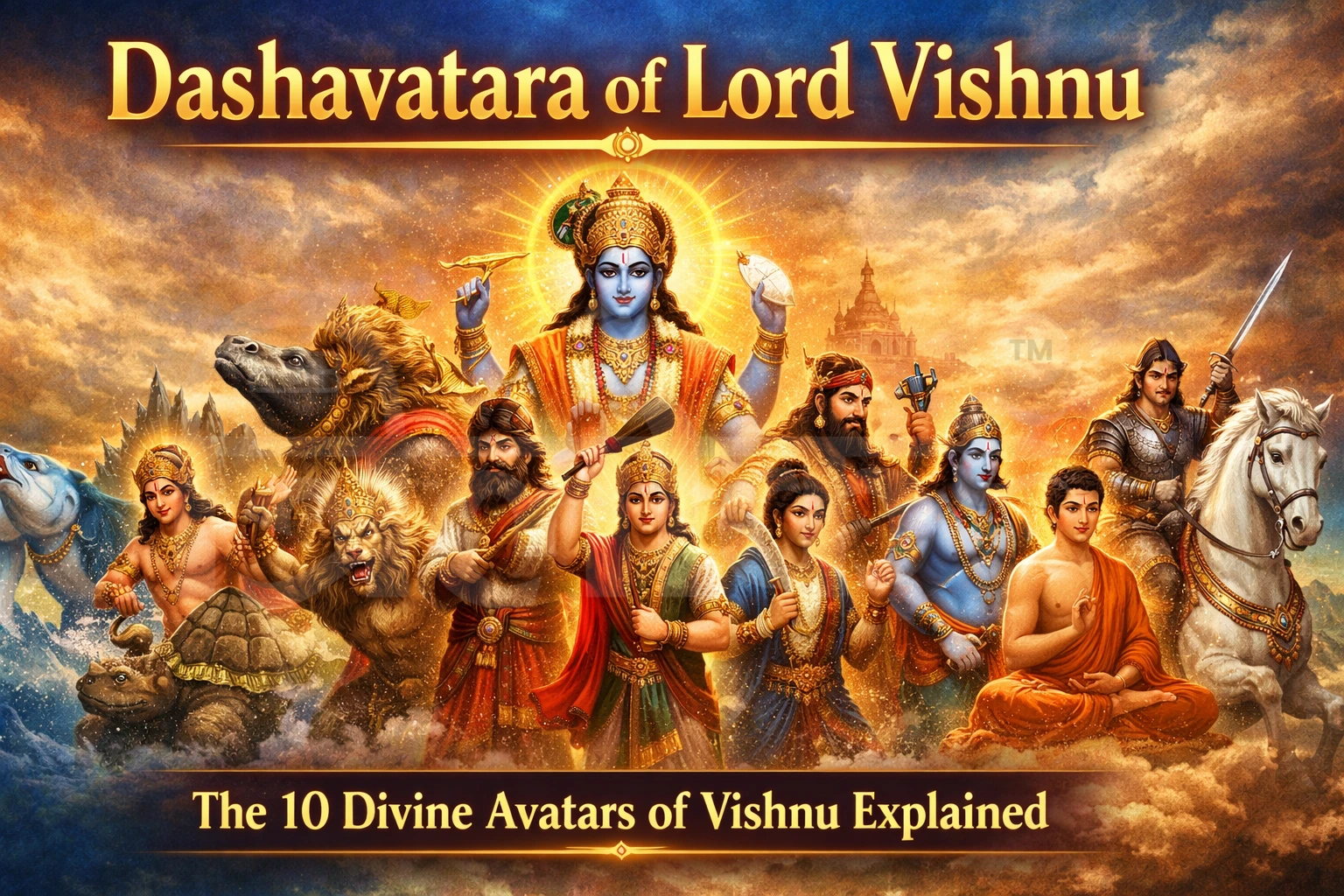


Why Lord Vishnu Takes Avatars
The Sanskrit word “avatar” means “descent,” referring to the descent of divine energy into the physical world. According to the Bhagavad Gita (Chapter 4, Verse 7–8):
“Whenever there is a decline in righteousness and an increase in unrighteousness, I manifest myself on Earth. To protect the good, destroy evil, and re-establish dharma, I appear age after age.”
Key Purposes of Vishnu’s Avatars:
- Restore Dharma: Re-establishing moral order.
- Defeat Evil: Neutralizing powerful demons or tyrants.
- Protect Devotees: Intervening when sincere followers are in danger.
- Guide Humanity: Teaching spiritual wisdom and moral values.
The Ten Avatars of Lord Vishnu (Dashavatara)
The Dashavatara appears across different ages of the universe to address specific crises:
- Matsya (The Fish)
- Kurma (The Tortoise)
- Varaha (The Boar)
- Narasimha (The Man-Lion)
- Vamana (The Dwarf Brahmin)
- Parashurama (The Warrior Sage)
- Rama (The Ideal King)
- Krishna (The Teacher)
- Buddha (The Enlightened One)
- Kalki (The Future Warrior)
1. Matsya Avatar: The Savior During the Great Flood
The Matsya avatar appeared when a great cosmic flood threatened to destroy all life and a demon named Hayagriva stole the sacred Vedas.
The Story of Matsya
King Manu found a tiny fish that eventually grew large enough to fill the ocean. Revealing himself as Vishnu, Matsya warned Manu of the coming flood and instructed him to build a giant boat to preserve seeds, animals, and sages. Using a serpent as a rope, Manu tied the boat to Matsya’s horn, and the divine fish guided them to safety while recovering the stolen Vedas.
Significance:
- The preservation of sacred knowledge.
- Protection during catastrophic destruction.
- The beginning of a new cycle of creation.
The Evolutionary Interpretation of the Dashavatara
Many scholars observe that the sequence of Vishnu’s avatars symbolically mirrors the biological evolution of life on Earth.
| Avatar | Form | Evolutionary Symbolism |
|---|---|---|
| Matsya | Fish | Life begins in water |
| Kurma | Tortoise | Transition from water to land (Amphibians) |
| Varaha | Boar | Development of land mammals |
| Narasimha | Half-man, half-lion | Evolution toward early human forms |
| Vamana | Dwarf human | Early stage of human development (short stature) |
| Parashurama | Warrior with axe | Primitive human society using tools |
| Rama | Ideal civilized human | Development of moral and social codes |
| Krishna | Philosophical guide | Intellectual and spiritual evolution |
| Buddha | Enlightened teacher | Compassion and higher consciousness |
| Kalki | Future warrior | Transformation and renewal |
The Dashavatara Across the Four Yugas
The incarnations are spread across the four cosmic cycles of time:
| Yuga | Vishnu Avatars |
|---|---|
| Satya Yuga (Age of Truth) | Matsya, Kurma, Varaha, Narasimha |
| Treta Yuga | Vamana, Parashurama, Rama |
| Dwapara Yuga | Krishna, Buddha |
| Kali Yuga (Current Age) | Kalki (Future Avatar) |
Final Thoughts
The Dashavatara represents the ongoing journey of the universe—from chaos toward harmony. For millions, these stories are powerful reminders that truth, justice, and Dharma will always prevail in the end.