
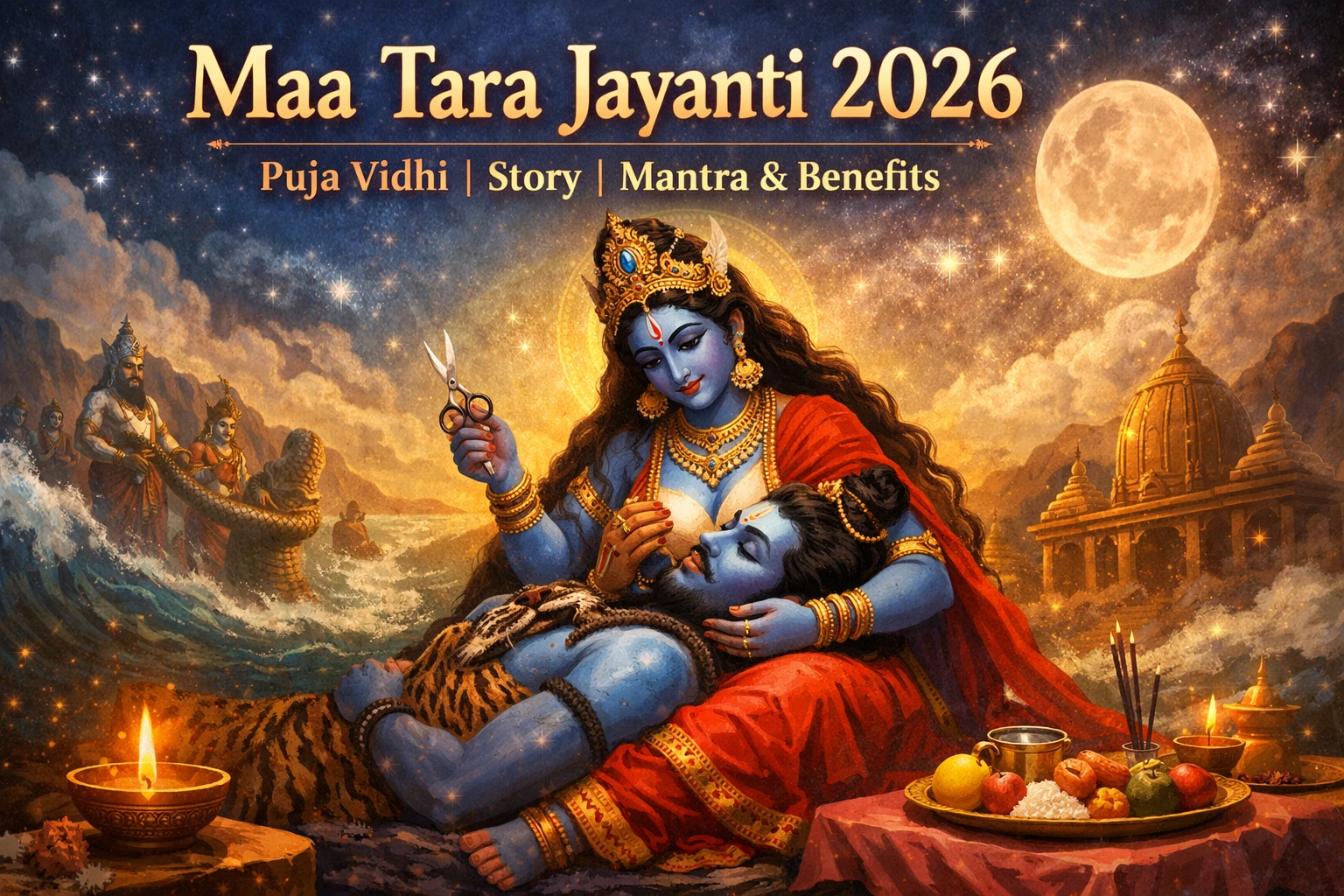
Maa Tara Puja Vidhi (Step-by-Step with Proper Explanation)
This is not just a checklist—it’s a structured spiritual process designed to shift your mental and emotional state. Each step has a clear purpose. Execution quality matters more than complexity.
1. Preparation (Sharir + Manas Alignment)
What to do:
- Take a bath and wear clean clothes
- Preferably choose blue-colored clothing
- Sit in a quiet, distraction-free space
Why this matters:
Preparation is about state change.
- Bathing = physical + energetic cleansing
- Clean clothes = psychological reset (signals a fresh start)
- Blue color = associated with Maa Tara’s frequency (calmness, depth, protection)
Outcome:
You enter the ritual with a focused and receptive mindset, not a distracted one.
2. Setup (Energy Anchoring / Altar Creation)
What to do:
- Place a clean cloth (blue or pink) on a flat surface
- Keep Maa Tara’s photo, idol, or even a coin
- Ensure the space is neat and uncluttered
Why this matters:
This step creates an energy anchor point.
- The cloth defines a dedicated sacred zone
- The image/symbol acts as a focus object for your mind
- Clean setup reduces cognitive noise
Outcome:
Your attention becomes centered, which is critical for deeper connection.
3. Deepak (Lamp Lighting – Activation Step)
What to do:
- Light a diya using ghee or oil
- Gaze at the flame for a few seconds
Why this matters:
Fire is used as an activation element.
- The flame represents transformation and purification
- It helps shift your brain from scattered thinking → single-point focus
Visualization strategy:
As the lamp burns, imagine:
- Stress = burning
- Fear = dissolving
Outcome:
You initiate the ritual with clarity and intention activation.
4. Offerings (Emotional Release Mechanism)
What to do:
- Light incense (agarbatti)
- Offer flowers (blue preferred, but any works)
Why this matters:
Offerings are not about materials—they are about internal release.
- Incense = symbolizes subtle energy (thoughts, emotions)
- Flowers = represent surrender and respect
Execution insight:
While offering, mentally attach:
- Your stress
- Your confusion
- Your fears
Outcome:
You offload internal pressure—this is a psychological detox layer.
5. Bhog (Gratitude Loop Activation)
What to do:
- Offer simple food (fruits or sweets)
Why this matters:
This step builds a gratitude feedback loop.
- It shifts your mindset from “lack” → “abundance”
- Reinforces humility and acknowledgment
Important:
No need for expensive items. Intent > cost.
Outcome:
You stabilize your emotional state through gratitude-based grounding.
6. Sankalp (Core Communication Layer)
What to do:
- Sit quietly
- Close your eyes
- Speak internally, like talking to a mother
Why this matters:
This is the highest impact step.
- You are not reciting—you are expressing
- Removes emotional suppression
- Creates a direct connection with Maa Tara’s nurturing aspect
Execution rule:
- No formal language
- No memorized lines
- Be raw and honest
Outcome:
Emotional clarity + internal relief
This is where real transformation begins.
7. Mantra Chanting (Mental Reprogramming Layer)
Mantra:
“Om Hreem Streem Hum Phat”
What to do:
- Chant 108 times (ideal)
- Or 5–10 minutes with full focus
Why this matters:
Mantra = sound-based neurological reset
- “Hreem” → activates inner energy
- “Streem” → connects with Maa Tara’s शक्ति
- “Hum Phat” → breaks negativity and blockages
Execution strategy:
- Focus on vibration, not speed
- Feel the sound internally
Outcome:
- Reduced overthinking
- Improved mental clarity
- Stronger emotional control
8. Prasad Distribution (Energy Closure)
What to do:
- Eat a portion of the offered food
- Share it with family
Why this matters:
This step completes the energy cycle.
- Converts offering into received blessing
- Sharing amplifies positive energy
Outcome:
A sense of completion, calmness, and connection.
This entire puja is designed as a 3-layer system:
| Layer |
Function |
| Physical |
Cleanliness, setup, actions |
| Emotional |
Expression, surrender, release |
| Mental |
Mantra, focus, clarity |
When executed correctly, the result is not just “ritual completion” but:
- Reduced stress load
- Improved decision clarity
- Emotional stability
Why Maa Tara Worship Matters — Deep Explanation
This is not just devotional positioning—this is a behavioral and psychological transformation model encoded in spiritual form. Each benefit maps directly to real-life performance and mental frameworks.
1. Removes Internal Blockages
What it actually means:
Internal blockages are not external problems—they are mental loops:
- Overthinking
- Fear of outcomes
- Decision paralysis
- Self-doubt
These create a lag in action-taking, which directly impacts life growth.
How Maa Tara connects:
Her energy is associated with clearing mental noise.
- The mantra vibrations reduce thought clutter
- The ritual creates stillness (interrupts overthinking cycles)
- The surrender process reduces internal resistance
Real-world impact:
- Faster decision-making
- Reduced anxiety before actions
- Clearer thinking under pressure
2. Cuts Negative Attachments
Symbol: Scissors in Maa Tara’s hand
This is highly strategic symbolism.
Negative attachments include:
- Toxic relationships
- Addictive habits
- Comfort zones that limit growth
- Emotional dependency
Most people know what’s wrong but can’t detach.
How Maa Tara works:
- Creates awareness + emotional strength
- Reduces dependency on external validation
- Helps you choose logic over attachment
Key shift:
From → “I can’t leave this”
To → “This is not serving me anymore”
Real-world impact:
- Better boundaries
- Healthier relationships
- Stronger self-control
3. Improves Expression & Confidence
Core issue:
Most people don’t lack knowledge—they lack clear expression.
This shows up as:
- Hesitation while speaking
- Fear of judgment
- Inability to say “no”
- Poor articulation of thoughts
How Maa Tara influences this:
Her energy is linked with voice and expression power.
- Reduces internal fear → improves external communication
- Aligns thoughts → speech becomes clearer
- Builds inner certainty → confidence naturally increases
Execution insight:
When your mind is clear, your communication becomes sharp.
Real-world impact:
- Better conversations
- Stronger presence in meetings/social settings
- Increased influence and authority
4. Emotional Stabilization
Core problem today:
People are not failing due to lack of skill—they are failing due to emotional overload.
- Stress
- Burnout
- Mood fluctuations
- Lack of mental balance
How Maa Tara helps:
Her core identity is nurturing under pressure (as seen in Shiva’s story).
- Provides a sense of internal support
- Reduces emotional volatility
- Builds resilience
Important distinction:
She doesn’t remove problems—
She increases your capacity to handle them.
Real-world impact:
- Calmness during chaos
- Better handling of setbacks
- Consistent performance under stress
Deeper Understanding of Maa Tara
This section translates Maa Tara’s significance into a modern, high-performance framework—making it easier to understand her relevance beyond traditional belief.
1. Maa Tara as a “Crisis Management System”
In her core story, Maa Tara appears only when the situation reaches a breaking point—when even Lord Shiva is unable to handle the internal impact of poison.
Interpretation:
- Crisis is not always external
- The real damage happens internally (stress, overwhelm, burnout)
Maa Tara’s role:
- She doesn’t remove the crisis instantly
- She stabilizes the व्यक्ति handling the crisis
Modern parallel:
In today’s environment:
- Work pressure
- Personal uncertainty
- लगातार मानसिक load
Maa Tara represents the ability to stay functional under pressure.
2. Mental Detox
Problem today:
The average mind is overloaded with:
- Constant information
- Negative thinking loops
- Comparison and anxiety
This creates mental toxicity, similar to the poison in the story.
Maa Tara’s function:
- Clears unnecessary thoughts
- Reduces overthinking
- Creates mental space
How it works:
- Mantra → sound vibration resets thinking patterns
- Silence during puja → interrupts mental noise
Outcome:
You move from:
- Confusion → clarity
- Noise → focus
3. Reset Mechanism
Every system—whether machine or human—needs a reset point.
Without reset:
- Performance drops
- Errors increase
- Emotional instability rises
Maa Tara acts as:
A reset trigger for your internal system
- Breaks negative momentum
- Slows down mental chaos
- Re-centers your focus
Example:
After a stressful day:
- Instead of carrying stress forward
- Maa Tara worship helps you reset before the next cycle
4. Clarity-Driven Action After Chaos
Most people don’t fail during chaos—
They fail after chaos, when they have to take decisions.
Common pattern:
- Mind is clouded
- Emotions are unstable
- Decisions become reactive, not logical
Maa Tara’s impact:
- Stabilizes emotions first
- Then restores clarity
Result:
- Better decisions
- Less impulsive actions
- Higher control over outcomes
Why This Matters Today
We are operating in a high-stimulation, high-pressure ecosystem:
- Constant notifications
- Career pressure
- Social comparison
- Lack of mental rest
This creates a continuous “poison intake”—not physical, but psychological.
Final Positioning
Maa Tara is not just a religious figure—
She functions as a 3-layer internal optimization system:
- Detox → Removes mental clutter
- Reset → Stabilizes internal state
- Clarity → Enables better action